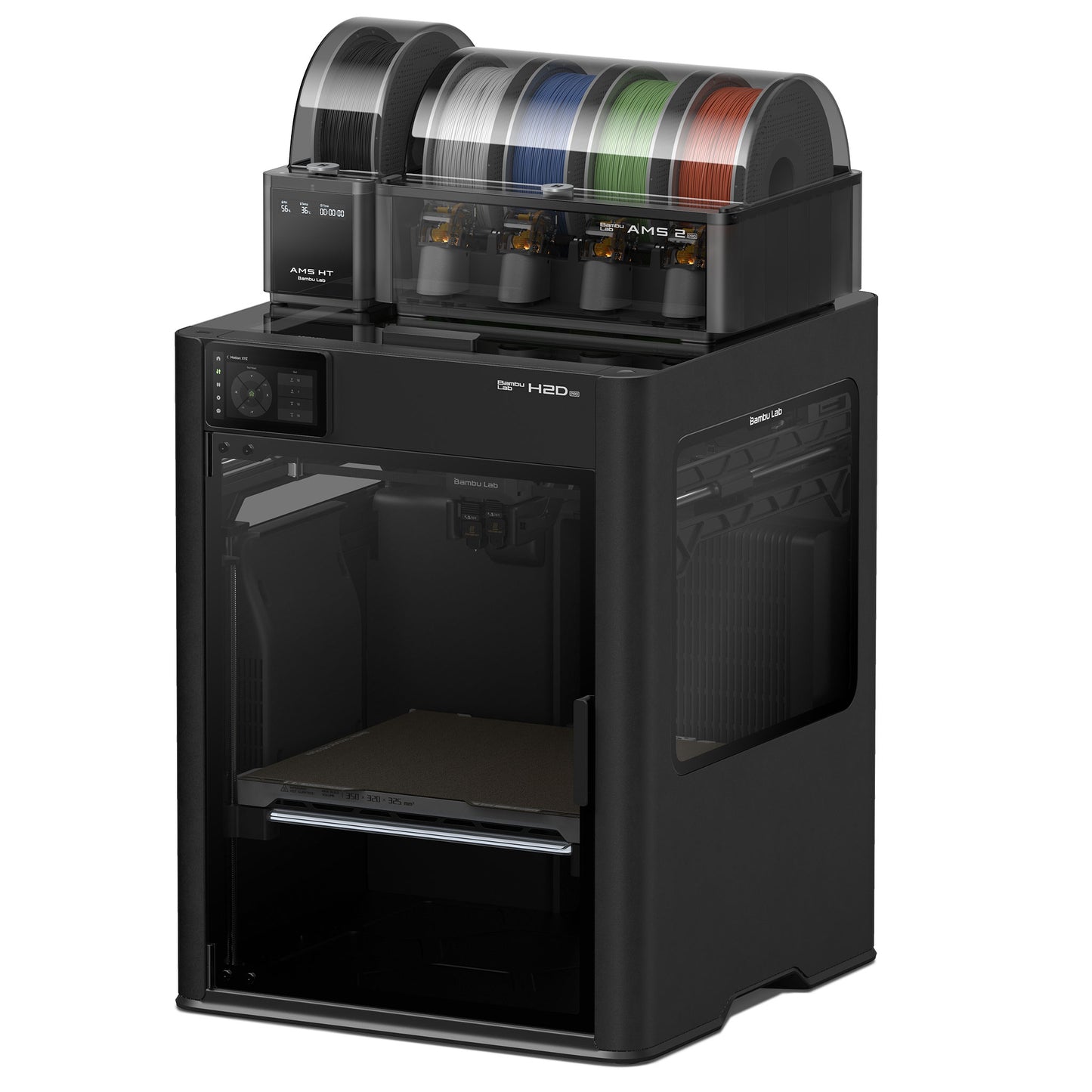
Bambu Lab H2D Pro 3-D Printer

Regular price $3,799.00
Regular price $0.00 Sale price $3,799.00
Grades 6-12

The Bambu Lab H2D Pro Brings Dual-Nozzle Manufacturing to Your Classroom or Makerspace

Regular price $3,799.00
Regular price $0.00 Sale price $3,799.00
Shipping calculated at checkout.

⚠️ Clearance Item - Final Sale

All clearance sales are final. No returns, refunds, or exchanges.

SKU: SKU:93996

Professional dual-nozzle 3-D printer with hardened steel nozzles, safety key access control, and AI-powered monitoring built for classrooms or makerspaces. Students print multi-material prototypes at speeds up to 600 mm/s while educators maintain control through the physical safety key system.

In Stock: Ships in 4 weeks.

Dual Nozzles
Dual Nozzles
Hardened Steel Nozzle
350 C Nozzle Temperature
Safety Key Included
Safety Key Included
WHAT'S INCLUDED
  • Bambu Lab H2D Pro 3-D Printer
  • Textured PEI Build Plate
  • Spool Holder
  • Accessory Box
  • Safety Key
SPECIFICATIONS & SAFETY
  • Brand: Bambu Lab
  • Quantity: 1
View full details
Bambu Lab H2D Pro 3-D Printer
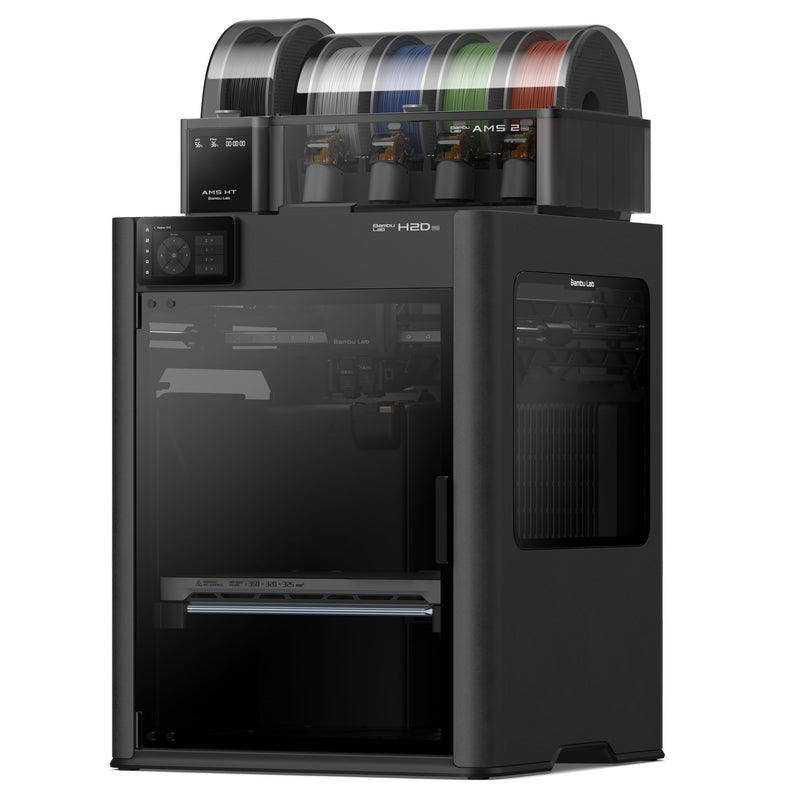
Bambu Lab H2D Pro 3-D Printer

Regular price $3,799.00
Regular price $0.00 Sale price $3,799.00

Frequently Bought Together

1
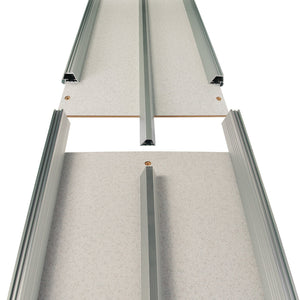
FasTrak® Elevated Racetrack
+
2
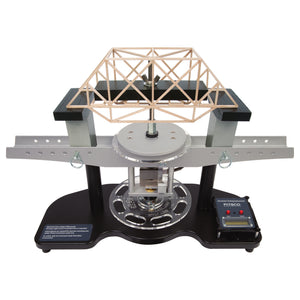
A Structures Testing Instrument with a turn-force wheel and a balsa wood bridge model on top, set on a black base with a digital load cell for measuring force.
+
3
black PLA refill filament

Total: $5,177.99 (3 items)
Bambu Lab H2D Pro 3-D Printer

Design It. Print It. Test It.

Students move from digital design to physical prototype in minutes, then validate their creations with Pitsco testing equipment—wind tunnels, load testers, and race systems that give 3-D printed objects real purpose.
Dual-Nozzle System

Dual-Nozzle System

Two independent nozzles enable multi-material and multi-color printing in a single print job, including dissolvable support materials.

Hardened Steel Nozzle

Hardened Steel Nozzle

Built to handle abrasive materials like carbon fiber and glass fiber-reinforced filaments without wear.

AI-Powered Monitoring

AI-Powered Monitoring

Smart sensors and cameras monitor every layer, detecting errors in real time.

Safety Key Access Control

Safety Key Access Control

Physical safety key gives educators complete control over printer access in shared environments, preventing unauthorized use during unsupervised periods.

What Students Will Do

Students design and manufacture professional-quality prototypes and functional parts using dual nozzles and advanced materials.
  • Design dragster bodies in CAD and 3-D print for wind tunnel testing
  • Print structural prototypes and test to failure on load testers
  • Create multi-material assemblies with soluble supports
  • Print custom rocket nose cones and fins for launch testing
  • Prototype gear trains and mechanical assemblies
  • Monitor print quality in real time through AI-powered sensors and cameras
  • Design and print bridge and truss structures for competition

Compare Similar Products

Feature Current Product
Bambu Lab H2D Pro 3-D Printer
Bambu Lab H2D Combo 3-D Printer Bambu Lab H2S 3-D Printer
Price $3,799.00 $2,549.00 $2,099.00
Build Volume 325×320×325 mm325×320×325 mm 340×320×340 mm
Dual Nozzles
Hardened Steel Nozzle
AMS Included
Carbon Fiber Ready
Safety Key
Best For Professional-grade dual-nozzle manufacturing with hardened nozzles for abrasive materialsDual-nozzle multi-material manufacturing with AMS automation Largest build volume with AI monitoring and 23 sensors
View Details View Details

Step-by-step

Step 1—Unbox and Set Up: Position the H2D Pro on a stable makerspace workstation. Connect to power and Wi-Fi. Insert the safety key to enable operation. Setup takes approximately twenty minutes.

Step 2—Load Filament: Insert filament spools directly into the printer. Dual nozzles accept two different materials simultaneously.

Step 3—Prepare Design: Use Bambu Studio (free) to import 3-D models, assign materials to each nozzle, and configure support structures. Slice and send via Wi-Fi.

Step 4—Print: Dual nozzles work independently—one prints the model while the other deposits soluble support or a second material. AI monitoring watches every layer.

Step 5—Remove and Evaluate: Remove the print from the build plate, dissolve supports if applicable, and evaluate. Test in the wind tunnel, on the race track, or on the structures tester. Iterate and improve.

Professional Manufacturing Starts Here

Digital Fabrication Fluency—Students develop the complete design-to-prototype workflow used in professional engineering: CAD modeling, material selection, dual-nozzle print optimization, and physical validation. This is the same pipeline used at aerospace and automotive companies.

Iterative Design Thinking—When a 3-D printed dragster loses in the wind tunnel, students redesign, reprint, and retest. The 600 mm/s print speed enables multiple design iterations per class period, building genuine engineering judgment.

Materials Science—Dual-nozzle, multi-material printing teaches mechanical properties hands-on. Students discover why PLA flexes differently than PETG, why carbon-fiber fill adds stiffness, and why support material choice affects surface finish and geometric complexity.

Support Materials

Videos, guides, and resources to help you get the most out of this product.

Why Teachers Love the Bambu H2D Pro 3D Printer

Professional-Grade Output

Professional-Grade Output

Dual hardened steel nozzles and AI precision produce functional prototypes that perform in wind tunnels, load testers, and racing competitions.

Educator Access Control

Educator Access Control

Physical safety key prevents unauthorized use, giving teachers complete control over when the printer operates in shared makerspace environments.

Abrasive Material Ready

Abrasive Material Ready

Hardened steel nozzles handle carbon-fiber and glass-fiber reinforced filaments without degradation across thousands of student prints.

Print-to-Test Makerspace Hub

Print-to-Test Makerspace Hub

3-D print dragster bodies and test in the wind tunnel, print structures and crush on the Structures Testing Instrument, print rockets and launch them—every print has a destination.

Multi-Material Unlocks Real Engineering

Multi-Material Unlocks Real Engineering

Soluble PVA supports enable complex internal geometries. Students print functional hinges, snap-fits, and assemblies impossible with single-nozzle printers.

Competition-Ready Fabrication

Competition-Ready Fabrication

Science Olympiad and TSA teams use dual-nozzle printers to produce precision dragsters, structural members, and multi-material assemblies that meet tournament specifications.

Flexible Purchasing Options

Pricing and volume discounts are built in—choose the path that fits your purchasing process.

Buy Online

Best if you know what you need and can buy online.

Ready to purchase now? Add this to your cart for fast, easy checkout.

Request a Quote

Need a quote for approval or purchase order processing?

Request a quote or connect with an Education Advisor before purchasing.

Request a Quote

Get Expert Guidance

Exploring options or planning a larger implementation?

Our Education Advisors can help with product selection, curriculum, and professional learning.

Book a Meeting

Frequently Asked Questions

What Pitsco products pair best with this 3-D printer?

The FasTrak Elevated Racetrack for racing 3-D printed dragsters, the Structures Testing Instrument 2.0 for testing printed structures to failure, and the X-Stream Wind Tunnel for testing aerodynamic shapes.

Can students 3-D print CO2 dragster bodies?

Yes. Students design dragster shells in CAD, 3-D print them with the dual-nozzle system, and test aerodynamics in the wind tunnel before racing on the FasTrak. The second nozzle can print weight inserts in a different material.

What is the difference between the H2D Pro and the H2D Combo?

The H2D Pro features hardened steel nozzles for abrasive materials like carbon fiber but does not include AMS. The H2D Combo includes AMS 2 Pro for automatic multi-color switching but uses standard nozzles.

What materials can students print with?

PLA, PETG, TPU, ABS, ASA, PC, PA (nylon), PVA (soluble support), carbon-fiber and glass-fiber reinforced filaments. The 350°C nozzle and enclosed chamber handle the full range of engineering materials.

How does the safety key work?

A physical key must be inserted to enable printer operation. Educators remove the key to lock out the printer during unsupervised periods, preventing unauthorized use in shared makerspace environments.

Can this printer handle a full class of students?

Yes. The 325×320×325 mm build volume accommodates large projects, and speeds up to 600 mm/s enable multiple student projects per class period. Dual nozzles reduce total print time for multi-material jobs.